
Social Value Malaysia

Search
×
Generic selectors
Exact matches only
Search in title
Search in content
Post Type Selectors

case study

Building Organisational Capacity to Practise Social Value

10 August 2026 | CAPACITY BUILDING |  Women of Will

Women of Will had an established programme model, reporting systems, and years of experience supporting women and communities facing disadvantage. The challenge was to strengthen its ability to understand change more clearly and use that learning in programme decisions. Working through SROI training and its engagement with Social Value Malaysia, Women of Will began to revisit how it listened to stakeholders, selected indicators, assessed outcomes, and connected evidence to decisions about resources.


The challenge: moving from reporting to learning 

Women of Will’s programmes support women in low-income and underserved communities, including public housing communities. Many participants run informal businesses and face barriers to conventional finance and formal business registration. 

The organisation was already measuring aspects of its work. However, Mohd Zulikhwan Bin Ayub, Executive Director, Women of Will observed that measurement could become too dependent on familiar indicators and established ways of working. The organisation needed to ask whether its systems were capturing the changes that mattered to women and communities. 

This created a practical capacity-building challenge: 

  • How could the team understand SROI beyond the technical language?
  • How could staff apply the principles across multiple projects?
  • How could established systems be improved without disrupting programme delivery? 
  • How could stakeholder learning influence decisions about resources? 

 The approach: building on what already existed 

The work did not involve replacing Women of Will’s programme model. It involved examining the model more carefully and strengthening the thinking behind it. 

Through SROI training and engagement with Social Value Malaysia, the organisation began to: 
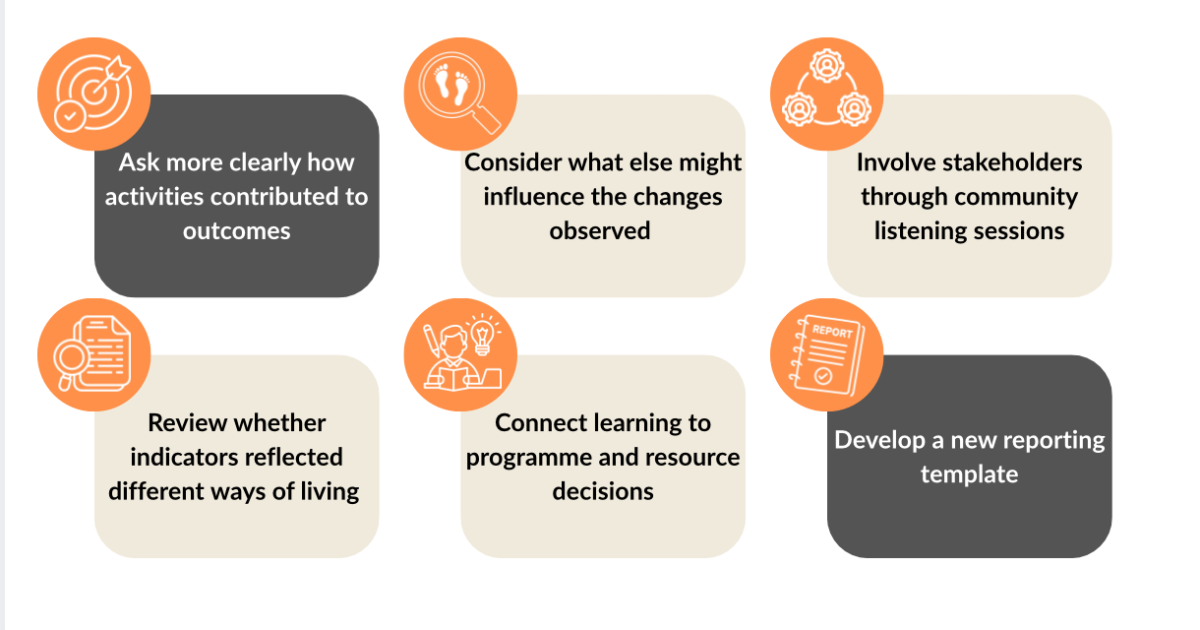
This approach recognised that organisational change requires more than introducing a new framework. It requires time, discussion, staff understanding, leadership support, and opportunities to apply learning in practice. 
What changed in the organisation’s practice? 

1. Stakeholder perspectives became more central 

Women of Will used community listening sessions to hear directly from the people and communities involved in its programmes. These conversations helped bring attention to emerging priorities, including issues affecting young people and senior citizens. 

The organisation began using stakeholder involvement not only as a research activity, but also as a reference point for programme thinking. 

2. Indicators were questioned and refined 

The example of savings showed why this mattered. Measuring only bank balances could miss participants who saved through gold or other assets. Reviewing the indicator helped the team recognise that the same outcome may look different across communities. 

The lesson was simple but important: indicators need to reflect people’s lived experiences, not only what is easiest to record. 

3. Programme decisions became more analytical 

SROI encouraged the team to ask why activities were included and how they contributed to change. Access to resources, for example, became recognised as an important factor in understanding empowerment. 

This helped the organisation move from asking only whether activities had been completed to considering how they supported outcomes. 

4. Resource use was reconsidered 

Zul described the organisation as looking more closely at what mattered to stakeholders and reconsidering activities that appeared less relevant or less likely to contribute meaningfully to its programmes. 

He estimated that these adjustments resulted in financial savings of close to 20%. This figure was expressed tentatively during the interview, and the interview did not specify the budget, period, or calculation behind it. It should therefore be treated as Zul’s estimate of an organisational benefit, not as an SROI ratio or a quantified measure of participant benefit. 


The implementation challenge: capacity and organisational inertia 

Women of Will was implementing this work alongside ongoing programme delivery. At the time of the interview, the organisation had close to 40 projects underway, generally lasting between 12 and 15 months. Staff needed to continue supporting communities while learning new methods, revisiting existing information, and adapting reporting systems. Securing team understanding and buy-in was therefore a significant challenge. 

Zul described this tension as “organisational inertia”: the gap between the changes an organisation wants to introduce and its capacity to implement them. The response was not to force change at one speed. Women of Will needed to strengthen communication, create shared understanding, and match its ambitions with the time and capacity available to the team. 

Leadership support was also important. 

“My board has been really supportive throughout the experience.” 
 

What the partnership demonstrates 

The Women of Will experience shows that building social-value capacity is an organisational journey, not a one-off training event. The value of working with Social Value Malaysia was not only in introducing SROI concepts. It was in helping the organisation apply those concepts to real decisions: 

  • what to ask stakeholders; 
  • how to define and measure change; 
  • how to test assumptions; 
  • how to improve reporting; and 
  • where to direct limited resources. 

The experience also demonstrates that social-value practice needs to be adapted to organisational context. A mature organisation with established programmes may not need a completely new model. It may need support to examine familiar systems with fresh questions. 

A process still underway 

Women of Will began implementing SROI in November 2025. At the time of the interview on 10 August 2026, its first full SROI report, relating to a project in Kedah, was expected towards the end of 2026. 

The interview therefore captures a stage in an ongoing process. It does not establish the final outcomes of the Kedah project or provide a completed SROI analysis. 

What it does show is how organisational capacity began to develop: stakeholder perspectives informed programme thinking, indicators were questioned, reporting systems were revisited, and learning began to influence resource decisions. 

Reflection

The visible output of social-value practice may be a report or a new template. The less visible work is the organisational learning behind it: building understanding, challenging assumptions, gaining buy-in, and creating the capacity to act on evidence. 

For Women of Will, the partnership with Social Value Malaysia helped turn SROI from a reporting requirement into a way of thinking about programme quality, stakeholder experience, and resource use. 

The work remains in progress. The next step is to document how these organisational changes influence programme delivery and, ultimately, the women and communities Women of Will serves. 

Related case study

Ready to Build Your Own Change?

If you’re ready to create impact in your own organization, we’d love to work with you.